Search This Blog

Showing posts with label communication. Show all posts

Saturday, December 17, 2016

Easy Print-Making: great holiday art activity for home or school

Print-making is a fun and versatile art activity that can be easily modified for all levels of language and artistic skill. The method demonstrated in our teaching video (see link below) is simple, allowing you to set up a print "studio" at home or in the classroom without spending a large amount of money.


You will need:
  • styrofoam trays (from meat and produce at the grocery store) - clean these well with soap & water, and make sure they are completely dry before you use them
  • wooden skewers or pencils - these are used to "draw" the designs into the styrofoam trays (making an indentation)
  • paint trays - we used cookie sheets covered with tinfoil (foil secured to the tray with masking tape)
  • water soluble print ink - you will have to purchase this at the art store (we used Speedball block printing ink and Nobel LinoPrinting ink)
  • paint/print rollers - these are also purchased at the art store, they are durable and made for multiple use (ours were Speedball brand, you'll find them with the print supplies)
  • paper - many kinds of paper will work, so feel free to experiment - in the video we used paper that we already had on hand (cartridge paper, rice paper, black art paper)

Basic method:

Draw out design ideas on sketching paper. Adam used markers to do this, but you could also use pencils - the advantage of drawing with markers is that it reduces the urge to constantly erase and "fix" a drawing.

Transfer the drawing ideas you like to the styrofoam trays (cut off raised edges so you are working with a flat piece of foam). This is where you will use a wooden skewer or pencil to press/indent the lines of the drawing down into the foam to create a "relief" drawing. Make sure the lines are indented well so that you get a clear print. The paint will stick to the areas around the lines.

Mix your paint on the paint trays. If you have multiple people using the trays, try to keep each tray to a colour "palette" that includes no more than 2 primary colours (eg. red & yellow, yellow & blue, blue & red) so you don't end up with "muddy" colours as they mix. That being said, have fun mixing your colours and also experiment with adding white and black ink. Print plates can easily be cleaned by running them under a tap. Or you can layer ink colours on the same print plate without cleaning in-between to get a different effect. There's no wrong answer here.

Use a roller to mix and transfer the paint to the styrofoam print "plate". Then you can either place the print plate paint side down on the paper & flip both over so the paper is on top, or you can put the paper on top of the print plate (whatever works out easiest for the person you are working with - the first technique allows better control over where the print is on the paper, but adds the potentially tricky motor step of flipping paper & print plate together without smearing/smudging the print).

Then use a clean roller (not the one you used to apply the paint) and roll on top of the paper to transfer the ink from the print plate to the paper. You can check the print by placing a finger in the middle of the paper and carefully lifting up one edge (to see if enough ink has transferred to make a clear design). Remove the paper carefully so the print doesn't smudge/smear. Then set it aside and let it dry.


Watch the video for more ideas on how to use this basic print technique to get many interesting effects:


if video doesn't play in your browser click this link: Print-making with Adam


Have fun and Happy Holidays from Autism and the Art of Communication!!

Wednesday, May 4, 2016

Teaching Nonverbal and Less Verbal People - Adam paints a self portrait

"Live as if you were to die tomorrow. Learn as if you were to live forever." 
~ Mahatma Gandhi

Adam writes and draws about our portrait painting class

Adam is an intelligent young adult on the autism spectrum who is less verbal and uses drawing and other art forms for communication. I first met Adam when he was just 3 years old and profoundly nonverbal. My job as a speech-language pathologist was to help him learn to connect and communicate with the world around him. What actually happened over the next couple of decades was more interesting - as much as I taught him, he taught me more. So at this point, I'll say that together Adam and I have discovered some effective ways to get around the barrier of imperfect verbal communication and give voice to the intellect and creative soul within. With Adam's permission, we now share some of what we've learned.


In the Art Studio:

Portrait teaching setup (Adam's easel on the left, my instructional model on the right, iPad photo reference and painting materials in the center)

You need a space that is friendly and comfortable for the student. The art studio we are working in is one that Adam's dad set up for Adam and his mom (who is also learning to paint). We have a generous work surface so that materials can be visually set out in an organized way. There is room for Adam (a tall guy) to step back and move around. Also important to consider lighting (need to see clearly, but not aggravate sensory sensitivies), sound environment (reduce background noise) and air quality (allergies, eg. free from mold & mildew).


Below are links to the two instructional videos that we made from our recent portrait painting sessions (posted on our YouTube channel AUTISMartCOMMUNICATE). These videos highlight and demonstrate some effective teaching strategies when working with less verbal individuals, including:

  • use of visual demonstrations
  • working from visual models
  • effective use of the iPad as a visual tool (takes & displays photos, allows zooming in on specific details)
  • verbal language should be clear, slow-paced and match demonstrated actions
  • back up verbal language with visual supports (to improve comprehension)
  • allow time for processing of verbal questions and instructions
  • repetition and rephrasing (of key information) can be helpful
  • resist "chattering" (remind yourself to leave quiet spaces)
  • SHOW more than TELL
  • gentle "hand over hand" can sometimes be useful when teaching a new motor skill
  • simplify language without "talking down"
  • allow the student to work at their own pace (don't rush)
  • student should be mostly calm, relaxed and enjoying the experience
  • okay for students to talk to themselves as they work
  • specific to portrait painting, be aware that autism can affect the individual's ability to process the human face
  • balance direct instruction with developing the student's artistic expression & style
  • art activities are a good context for language learning 
  • assume competence (and that all of your words are received and understood)


Part 1 (from the first hour-long painting session):


(if the video won't play click this link: Adam paints a self portrait - part 1 )

And Part 2 (from our second one-hour portrait painting session):


(if the video won't play click this link: Adam paints a self portrait - part 2 )


We hope you find these videos helpful and that you try out some of the methods in your own classes and studios. There is a lot of untapped artistic potential in the autism population, and many new artists waiting to learn new ways to express themselves. We would love to hear about your experiences.


We'll end this post by sharing Adam's completed self portrait. He has a bold and expressive artistic style that comes through in all of his art work, and is all his own. I love it:

Self Portrait by the artist, Adam V

Thursday, April 30, 2015

R-E-S-P-E-C-T

"One of the most sincere forms of respect is actually listening to what another has to say" ~ Bryant H. McGill


We're reaching the end of another April, with lots of public discussion about autism. One message that has been coming out loud and clear in recent years is that many people on the autism spectrum are not feeling respected, or "heard" in this discussion ... that has to change.


Most of the people talking about autism are well-intentioned - we want to help people or a particular person on the spectrum to be successful, to have an easier life, to have a good future. The intentions are not the problem, but where we go from there can be (we all know what the road to H-E-double hockey sticks is paved with). Too many times, we (as therapists, educators and parents) charge ahead with ideas and programs and interventions that WE think are best, that WE think should happen, that WE think others should comply with. We don't ask, we tell.


Social mis-step in the high school hallway - drawn by Adam


The picture above was drawn by Adam in high school. It was part of untangling a larger social problem he was having in the school hallways as he would take the shortest route from point A to point B, accidentally walking between people who were having conversations. The interesting part of this picture (to me) is the facial expressions - Adam aware that he had once again violated some unwritten unspoken social rule, causing other people to be upset with him, but no idea exactly what had gone wrong or how he could fix it (a common experience for people on the autism spectrum - neurotypical humans are ridiculously intolerant of social mis-steps).

A few questions for you: Why is Adam wrong? He has no bad intent, he's just trying to get to his next class. Why is the chattering social majority in the right? Shouldn't they actually be getting to class too?


True solutions to the mis-match between widely held social customs and one individual's unusual approach come through communication. Not communication as in telling the individual how wrong they are to do things the way they do, but communication that starts with listening to the individual to find out what things looked like from their perspective, what their thought process and intent was, what was okay, what was upsetting. Followed by discussion to fill in useful information that may not have been received by the individual. And only after that whole process of information exchange, and clarification of the situation, figuring out a solution that takes into account all sides, all perspectives, with the person on the autism spectrum as an active and powerful participant.


Communication is power, but only if other people listen to and respect that communication. We need to start listening better:


click the link below if the video doesn't automatically play:


Sunday, March 15, 2015

With a little help from our friends


"It is during the worst times of your life that you will get to see the true colors of the people who say they care for you" ~ Ritu Ghatourey


A few years back, I wrote a blog post called Comfort in a cold world featuring some beautiful red socks that a friend had given me in the midst of a very difficult time in my family. Well, the difficult times have returned, and when I saw this friend a few days ago, she gave me another pair of cheerful red socks (this time with monkeys!) to once again let me know that I'm not alone:


As I was sitting and looking at the monkeys, I was reminded of a story that Adam drew in 2012 - a story about friendship in times of need. So here it is, straight from the mind of Adam, who understands how difficult the world can be, and also knows the importance of a friend's helping hand when life sends you into free fall:

drawn by Adam, 2012

drawn by Adam, 2012

drawn by Adam, 2012

drawn by Adam, 2012

drawn by Adam, 2012


We need our friends and family, our human connections, because life is hard and full of perils. When we are surrounded by people who care about us, no matter what each day brings, we can get by with a little help from our friends. 


Thanks to Adam for illustrating this truth in such a vivid and memorable way (with monkeys!) ... Sheila B


"My friends and family are my support system. They tell me what I need to hear, not what I want to hear and they are there for me in the good and bad times. Without them I have no idea where I would be and I know that their love for me is what's keeping my head above the water." ~ Kelly Clarkson


Friday, February 13, 2015

Autism and Unspoken Love

"What's in a name? That which we call a rose by any other name would smell as sweet" ~ William Shakespeare, Romeo and Juliet


Can love be understood and experienced if a person can't even say the word? 

There is a common misconception that individuals on the autism spectrum are emotionless, and that misunderstanding is magnified when an individual is also non-verbal (for more on the this topic, read this blog post from our archives: Drawing Out Emotion in Autism - May 2013) My experience (working with many ASD people over the years) has been that while emotions in autism may not be easily named or conventionally expressed, they are certainly strongly felt.


So, on the topic of understanding love, I would like to share a visual story that Adam drew years ago when he was in elementary school and mostly non-verbal. At that time, he was often overwhelmed by the larger world, and to most people he looked like he had two states: sort of okay and distressed. Those of us who were privileged to know him better would also see laughter and excitement (usually connected to the action cartoons that he loved to watch time and again), but he didn't physically convey more subtle emotional states.

One day, I gave Adam a "story starter" picture of a man with a fishing pole, hoping to get some sort of "action and reaction" coherent storyline. The first four frames of the story are definitely action-packed:


Man and fish: part 1 ... drawn by Adam, 2001


But frames 5-8 of the story were an interesting surprise:


Man and fish: part 2 ... drawn by Adam, 2001

... self-satisfied man (thumbs up!) leaves the fishing spot carrying the "catch of the day" and brings it home with a smile to his wife, she in turn cooks up his fish offering and then the two of them sit down to a lovely seafood dinner. A warm picture of love shared between a man and his wife.

Once again, Adam's drawn communication had revealed thoughts, feelings and social understanding that were not at all evident in his interactions with the world. He showed us that he understood the emotions of love and caring for other people and knew how people expressed those emotions in their actions and interactions. Not being able to say it in words or facial expressions or physical actions did not mean that he was unable to feel the emotions or intellectually understand the social dynamic. Even though we set the bar high and believed in Adam's ability, we had underestimated the complexity of thinking he already had - a valuable lesson for all of us, and one that has been repeated and reinforced many times over the years since he drew this story.


More and more non-verbal autistic individuals are finding alternate ways of communicating (through typing, through art, through music). What these individuals show at a surface level is often not at all what's happening underneath. Presume competence, develop alternate communication channels, listen carefully and respect the autism perspective.

"All people with autism must be offered some way to communicate because we have minds, and thoughts, and feelings ... Life is beautiful the autistic way." Henry, 14-yr-old with non-verbal autism who communicates by pointing to a letter board (from his Roses are Red for Autism blog)

Wednesday, January 21, 2015

Everybody could use a sidekick!

Today's post is inspired by my dear buddy Will (my youngest nephew). Will and I have been spending a lot of time together recently, and I have been thoroughly enjoying the chance to look at the world through his eyes.

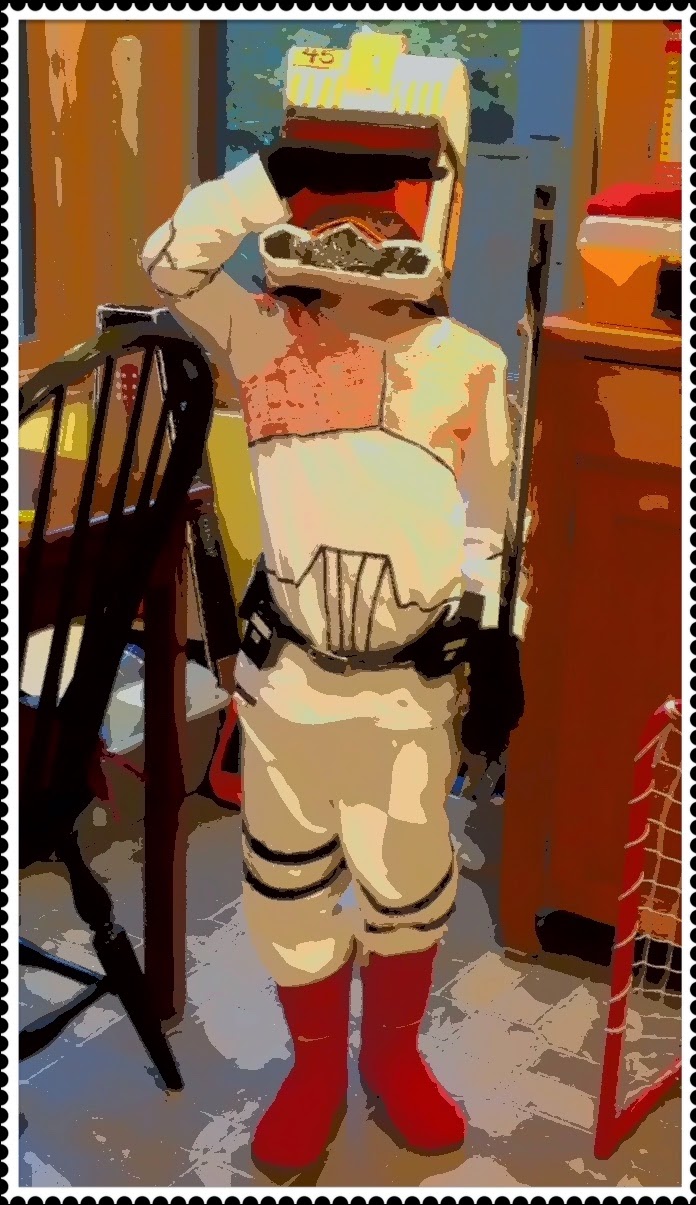
Will in the Clone Trooper costume he commissioned me to create for Halloween


Will is an original - a strong-minded imaginative child who sees the world in a distinctly different way. His mom (my sister) often rightly refers to him as "Won't".  Depending on the circumstances, you might see him as a fabulously different thinker who turns the ordinary world on its ear, or alternatively, as a child who stubbornly refuses to comply with your (to him arbitrary) demands.

May I just qualify the rest of this post by stating for the record that I love this boy - when he's "good", when he's "bad" - love him. He reminds me a lot of myself as a child. Thinking thoughts that don't match the majority, coming up against the pressure to comply, to be "usual". Interesting to be bright and eccentric, but not always comfortable.

I am Will's "sidekick". I play the roles he writes for me in his imagination dramas. I don't argue about the parameters, I follow his lead. A gift from me to him that I hope he will someday regift to his own undoubtedly strong-willed out-of-the-ordinary future children.

I wear the costumes he chooses for me from the "Tickle Trunk", his costume bits treasure trove, (if you're unfamiliar with the term "Tickle Trunk", please look up Mr. Dressup, a Canadian childhood icon). I embrace the powers he bequeaths to me. I act out the effects of his magical attacks (including the memorable "tornado of doom" which ended with me breaking my sister's cabinet door with my head ... but I digress, that's a story for another time). I happily follow him through the neighbourhood wearing items like a too small purple hockey helmet and fighting invisible foes in the bushes (trusting that the neighbours understand).

Together we adventure through the world of Will's mind - I learn about him and he discovers that I am his true friend. A gift for both of us.

Will as Robber Baron (not pictured: me as "robber sidekick" dressed all in black in a costume chosen by Will)


So what's the connection to autism? Individuals on the autism spectrum are developing outside (often way outside) the "usual". There is a tendency to view this unusual developmental path as somehow deficient, rather than just "different". When I do therapy with young children (no matter the diagnosis), I want to know what the world looks like through their eyes. What do they love? what are they thinking about? what do they dream? what do they want?

There is no better way to find out the answers to these questions than becoming a "sidekick". Put your own worries and demands to the side, even for an hour, and follow children into their world. Pay attention to what catches their attention. Follow their will and their wishes, as much as you can figure them out. Are they fascinated by the patterns of sunlight painted on the carpet? Take a close look, you may find it beautiful too. Do they want to wear a cowboy hat and run up and down the stairs? You can do that with them. You are more likely to hear meaningful communication when children are pursuing their own interests and passions, and you are right beside them sharing the experience.

Also interesting that the more children are convinced that you are truly interested in their world, the more likely they will trust you enough to take your hand and bravely take steps out into your world.


Historically, too much autism "therapy" has been focused on getting children (and teens and adults) to "comply". I don't much care for compliance. I would rather hear what a person is really thinking, even if it's diametrically opposed to what I originally thought would be more convenient. Then we can have a conversation, understand each other and move on from there.


me at one of our Typical Teen group meetings (2008)

Dignity is over-rated and full-on passionately embracing the fun in life is under-rated. Set your conventional views of age and self-respect on the shelf, get down on the floor and follow your kids. You won't regret it.

Monday, December 1, 2014

Karaoke as Curriculum: teaching through musical passion

It's December already! ... and what better way to start off this festive month than with a gift of music. I'd like to welcome back my guest blogger Carole (Kevin's mom) who has been using Kevin's love of music to happily teach language and literacy:


Picture drawn by Kevin


And now, here's Carole:

"When you raise a child on the ASD spectrum, a child who doesn’t just pick up skills, and learn naturally like other children, you become painfully aware of how incredible those early years of learning really are. You see other children learn to mimic, speak, understand, read cues, watch and follow. It’s phenomenal how much is learned in such a short space of time, and apparently so effortlessly. For the rest of us, there is an overwhelming void, and we have to decide what to teach, when to teach it, what is the priority, and figure out how so much can be taught without overwhelming our little ones. For my adult son, I still find myself deciding on his behalf, what, when and how to teach. If you’re anything like me, this can be a little overwhelming at times, and the responsibility of deciding for another adult what they need, or should know feels a little like making choices that shouldn’t be mine. I recently wrote to someone, and I shared that my middle aged brain prefers the KISS method, (keep it simple stupid) because frankly that’s about all it can handle. Then it occurred to me, that’s exactly the approach I use when teaching my son.

Teaching an unwilling student is painful at best, so I have always taken the things he loves, and tried to incorporate as much curriculum as I can in them, so that it never feels like work. It also allows me to teach skills that don’t necessarily fit his development at that moment, but hopefully will be there at the ready when the time comes. So for example, my guy has very limited speech, he reads but comprehension is very limited, and his auditory processing has always been a huge issue. So the question becomes, how do you get him to make more utterances, and practice the motor part of speech, and do you put the effort into improving his reading ability when the comprehension is not there? What if miracle of miracles, one day that comprehension kicks in and his reading is lacking, or suddenly he finds his words but has a hard time getting them out there, because he’s never practiced? I still believe that anything is possible for him, and I don’t want to think I didn’t raise the bar in expectation of that. So this is one example of how we took one of Kev’s delights and although he didn’t know it, turned it into curriculum.

Kevin loves music, and always has. As soon as I realized that, I had him listening to every genre of music I could find, and often you would hear me singing conversations to him (never in public!) So when we decided to hire a worker for a couple of mornings a week, how serendipitous was it, to discover she was a singer with the most beautiful voice – and karaoke began. It began slowly, he would cough a lot, unused to using that voice. He could only sing in the key of the song, and so we had to find songs in his register only. He couldn’t read, and vocalize quickly enough to sing along, so we had to start with very slow songs, and he had trouble with the reading.

Video of Kevin doing Karaoke:


Today, it’s his favourite activity, and we’re all kitted out with microphones for the computer, and a huge playlist from youtube. He can harmonize, it doesn’t need to be in his register anymore. He reads so much better, but we continue to have the lyrics on screen and the singer in the background, so that he hears when he reads a word incorrectly and learns to correct. He reads quickly, his inflection is great, his speaking voice is slightly less robotic, and although you will hear coughing, it is much reduced. Although he’s never going to be a rock star, the anticipation in his face as he awaits karaoke time speaks volumes, and it also happens to be my favourite time of the day too.

So I urge you, follow their lead, how can it ever be wrong when it brings them so much happiness? Once in a while you may even get some validation for following your intuition!"


Well said Carole! You always get the best learning at the point where passion and fun meet - when you find that sweet spot, everyone has a great time and the skills you teach stick.
~ Sheila B ~


note: for those who are interested in the research, here's a recent reference provided by Carole:

Fronto-Temporal Connectivity is Preserved During Sung but Not Spoken Word Listening, Across the Autism Spectrum.
Sharda M, Midha R, Malik S, Mukerji S, Singh NC.
Autism Res. 2014 Nov 5.


!


Friday, October 24, 2014

Refusing to live in fear

“I must not fear. Fear is the mind-killer. Fear is the little-death that brings total obliteration. I will face my fear. I will permit it to pass over me and through me. And when it has gone past I will turn the inner eye to see its path. Where the fear has gone there will be nothing. Only I will remain.” ~ Frank Herbert, Dune

"Cowardly Dog" drawn by Adam


We've all experienced fear - a basic human emotion with a very basic function: to keep us alive in a dangerous situation.

If we're being chased by a lion (or in Adam's cowardly dog scenario, a hungry fox), a flood of adrenaline that heightens our senses and prepares us to run away fast is an extremely useful physiological response. Also helpful are the safety lessons learned from fear (like "don't go into that dark cave") that might keep us alive when similar situations come up in the future.

But everyday life is not often about outrunning predators, and if you ask people about their fears, lions and tigers and bears (oh my!) are not usually at the top of the list. Instead, our fears focus on things that are less tangible - failure, loss, pain, the unknown or unexpected, separation from loved ones - diffuse fears that can last much longer than a few minutes of fighting for your life. When these are the demons you face, an adrenaline-fueled "fight or flight" response is not so helpful.

A common topic in therapy sessions with my students is that emotions aren't wrong or right, they're simply how you feel, although it's useful to be able to name an emotion, and then logically understand how it connects to your actions and choices in the larger world. When you choose to let fear stay in the driver seat of your life, logic doesn't just take a back seat, it often jumps right out of the car ... and fear and panic-filled choices rarely take you where you really want to or should go.


"Running Scared" picture drawn by Adam


So what to do?

"Fear is the mind-killer. Fear is the little-death." ... these words from Frank Herbert's novel "Dune" often run through my head when I find myself letting fear get the upper hand in my life.

Fear kills joy and robs us of happiness in the present tense. It may sound cliché, but today is the only time you actually have - the past is memories and the future is imagination. If you make the compromise of saying "well of course I'm worried, look at what happened yesterday" or "anyone in my situation would be scared witless of what's coming next", you choose to lose the moment you're in. You sacrifice present joys, no matter how small, for the pale satisfaction of being proved "right" if the worst should come to pass in the future. The tough part about this is that we seldom understand, in the moment, that this is the choice we are making.

This was a lesson we had to learn early on in our family life. Our second child, our daughter, was diagnosed with cancer shortly after her first birthday. My husband and I were a few years out of school, barely used to being "mom" and "dad", no financial resources (actually negative financial resources since we'd been living on a post-doc salary) and two children under the age of three. It's not easy to fight fear when you're living in a paediatric cancer ward and all that you hold dear is in jeopardy - even harder when you both have the science background to understand exactly what the diagnosis means and how slim the chances of a positive long-term outcome are. So we had a choice, actually we had to choose again and again, day after day ... to live happy, to live our lives as a family in and out of the hospital to the best of our ability. And you know what? After the initial shocked weeks, we did it. I look back on the pictures from that time and I see us laughing and playing and having fun ... when we had to cry, we cried at night in the dark ... no one could have given our daughter a happier life than we did. And we didn't get a miracle ending, and we didn't dodge the pain and sorrow that came with losing her, but we have no regrets about the full and joyful life we lived while we had her with us.

No one knows how long they have with the ones they love. What a shame to waste days in a cloud of fear and anger and "why me?". Cry when you must, seek out solace from friends and family, but don't live in darkness and sadness. Find the joy, hold on to the funny and the sweet and the dear bits. Love the day you're in, love the people you're with, love the life you have. Look fear in the eye, stare it down and refuse to let it rule you ... and expect to choose and choose again each day.

Because today is the only day you have.


... and let me end with a quote that I heard a short while ago, at the beginning of another difficult time in our family ... I would love to tell you the source of this quote, or even the exact wording, but no matter how I search, I can't find it ... so let me just attribute this piece of wisdom to "unknown" and hope that you might find it as helpful and hopeful a piece of advice as I did:

"Doubt your fears at least as much as you doubt your hopes and dreams" ~ Unknown

(... and live the h*ll out of the day you're in)


Thursday, August 21, 2014

The gift of free time

"Kids need time to be bored; that is how creativity is born" - Melanie Jean Juneau 

When I was a child, summer was my favourite time of year. I would wake up each morning knowing that the day was mine, that anything could happen, and that as long as I showed up relatively unscathed at mealtimes my mother would ask very few questions about how I was spending my time. My brothers and sisters and I explored, created, imagined, read, and ran free. Summertime felt endless and we were the luckiest of people. If I had to point to one factor in the successful development of my happily eccentric brain, it would be that yearly summer freedom.

School can be hard and confining, especially for an active person with an unusual flavour of mind. I feel very strongly that summer programs for individuals on the autism spectrum should not be anything like the school year. As the old saying goes, "a change is as good as a rest", and summertime is perfect for releasing arbitrary structures and giving those unusual and interesting minds a chance to run free, led by their own curiosity, imagination and interests.


Allow me to share the summer chapter of my young friend Kieran's artistic, communication and intellectual development
(to read the back story, click here - part 1 and here - part 2 )

I'll let Kieran (in pictures) and his mom (in words) tell the story themselves:


E-mail #1: Kieran found the Usborne book "Playtime Activities" in his room. I explained that these were instructions on how to draw different things. I love this lion he drew!


E-mail #2: He' s on a roll- he just drew this in my notebook:


He has been talking to me about building a growing machine for the last few days, which I connected to one of the Little Critter stories (I think it's When I Get Bigger) ... I told him that he couldn't make a growing machine out of wood, but that he could make one out of Lego. I'm guessing he didn't like that idea and decided to draw one instead.

I'm delighted that it made your day!


E-mail #3: Here's a car crusher that he built yesterday after watching Mighty Machines. The car crusher is lego and he wrapped some toy cars to crush.


Your advice to let him have an unstructured summer was perfect.


It is a damaging myth that people on the autism spectrum lack imagination and creativity (food for thought: read this blog post from Jonathan Alderson ). The development of creativity and imagination require less-structured (or unstructured) time and open-ended situations. When we fill up every minute in the day with "educational" activities, when we set up learning environments where there are limited "right" answers, when we allow no time for a person to follow their own interests and ideas, we stifle the growth of what is arguably the most important intellectual ability that humans can possess.

“I am enough of an artist to draw freely upon my imagination. Imagination is more important than knowledge. Knowledge is limited. Imagination encircles the world.”               ~ Albert Einstein 

Give unstructured time a try - you won't regret it and your kids will remember it for a lifetime 

Tuesday, July 8, 2014

Drawing to Communicate: making sure your message is received!

This morning I received the kind of message that totally recharges my "therapist batteries".

In a recent post (click here to read "Drawing for Communication: how to get things started"), I wrote about Kieran, a young boy on the autism spectrum, who was beginning to use his newly developed drawing skills to communicate. Earlier today, his mom sent me an update by e-mail:

"We were chatting about having an outing ... either to Carp Market or the beach at Fitzroy Harbour Provincial Park. Kieran was in the room when we were talking and said that he wanted to go to the beach. We acknowledged his input, but I think he wanted to make really sure that we understood - he got a piece of paper and a pencil and drew this for us!"


Yay, triple yay for Kieran! He used his new drawing communication skills to make sure that his important message was received by his family (who were happy to accommodate his wishes in the family schedule for the day).

Being able to clearly communicate your thoughts and wishes to others (who will listen to and respect that communication) is the strongest strategy for short-circuiting difficult behaviour and melt-downs - knowing that you're "heard" makes all the difference.

Thanks so much to Kieran and his family for allowing us to share this story .... Sheila B


Posted using BlogPress from my iPad

Monday, June 23, 2014

Drawing Together for Communication: how to get things started

Drawing can be a useful tool for developing communication skills in young children, and in older children (and teens and adults) with communication delays.


One of the techniques I commonly use in therapy is "collaborative drawing", where each person contributes to the larger drawing, and the drawing itself acts as a visual record of the conversation or story. Take a look at this video (made with my typically developing nephew Will when he was 4 years old) for a short demonstration of this technique:


Today I want to share with you some interesting developments from one of my young friends on the autism spectrum. Kieran is a bright active young boy (in grade 4) with delays in the development of his verbal language. He is very visual and is a whiz at math and putting together complicated building toys using diagram instructions. For the past two years, his family and I have been drawing things for him, making visual representations of what happens in our toy play and also of situations and interactions from the larger world around him.

During our early sessions, he was happy to have others do the drawing. The drawing was a good anchor for our conversations during play and this helped his focus, his comprehension and his verbal language development. Following our drawing/play sessions he liked to have the big drawings posted on the walls at home so he could look at them, think about them and talk about them with his family.


Then, at the beginning of this calendar year, Kieran started to take a more active role in the drawing process.


He began to frequently tell me what to draw and how to draw it. For example, this "portrait" of him and his cat was drawn in January according to his very detailed instructions:

portrait of Kieran in cowboy hat & tractor pyjamas (drawn by me, directed verbally by him)

He started drawing spontaneously to express himself - here is a picture, also from January, that he drew when his mom was drawing out some challenges from the school day (his suggestion ... how about going to Monster University?):

"I want to go to Monster University"

He has begun to draw collaboratively, adding details and figures to our large drawings (that we do beside our toy play), so now those drawings include his direct visual thoughts as well as his play ideas and what he has verbally directed me to add.

Here's a drawing from February where we explored the difficulty of loud noises and emotional responses to various situations - at the end of our session, he spontaneously added his two cats:


this "big picture" is done on 2 ft x 3 ft paper beside our toy play area
(this day we were playing with trains & plasticine figures)

Kieran's cat Ginger

Keiran's cat Spooky
 
Then at our last session in April, he added multiple details to our picture about Thomas the Tank Engine and friends:
 
Kieran added tracks and faces and smokestacks and many other details


What are the benefits of going after communication in this context?
 
First and foremost, it's fun and relaxed, and it makes formidably difficult skills (communication and social interaction) more approachable and accessible.
 
Second, it stimulates communication development in a very natural context, so the language learned is already generalized to where it's functional and fits.
 
Third, it lets the individual (who is the target of the therapy) set the pace - you can be certain that the information is going in, and they will show you when they have enough information and confidence to give the new skills a try.


Because we have never forced the issue, Kieran continues to willingly taking steps forward, trying new things and gaining confidence daily.
 
I leave you with his latest creation, a plasticine cat modeled after the many little plasticine animals I have made for him during our play over the last year - as you can see, it's a great cat with lots of personality and a happy disposition ... just like the young artist who made it.
 
Kieran's clay creation