Search This Blog

Tuesday, September 6, 2011

To socialize or not to socialize .... that is the question

Many of the people who choose to work in the "helping" and teaching professions are very out-going, chatty and sociable people. Usually this works to everyone's advantage as most jobs in these fields involve friendly interactions and discussions with many different people over the space of a work-day. Over time, "folk wisdom" in the therapy/teaching sphere has formed an image of what "normal" social behaviour looks like ... and it looks a lot like the chatty interactive social style of the extroverted people who dominate these professions. Programs that are set up to teach social skills often have the goal that participants will eventually match this "norm".

But maybe that's not what's normal for everyone. If you're working with people on the autism spectrum, perhaps a better "target" social style is embodied by an engineer or a scientist or a math major. I know (and like) many engineers ... my dad, my brothers, my brother-in-law, my uncle, not to mention all the engineering and computer guys I meet in the course of a work day ... and while engineer stereotypes are over-simplifications, they also hold a fair chunk of "real-world" truth. The best thing about engineering humour (of the printable kind) is that the engineers enjoy it as much as anyone (although their comment is more likely to be "well of course, that makes sense"). Here is a comment on engineers and social interaction that I think fits this discussion:

"Engineers have different objectives when it comes to social interaction. "Normal" people expect to accomplish several unrealistic things from social interaction: stimulating and thought-provoking conversation, important social contacts, a feeling of connectedness with other humans. In contrast to "normal" people, engineers have rational objectives for social interactions: get it over with as soon as possible, avoid getting invited to something unpleasant, demonstrate mental superiority and mastery of all subjects."  www.engineeringhumor.com
 Does this sound like anyone you know?

a quick sketch I made for one of my teen clients
to explain the term "breaking the ice"

 
The teen-age years are excruciating for many of us ... for those who are struggling with the social side of life, they can become unbearable. Many teens with a diagnosis of AS become weary of their lack of social success and retreat to their rooms, pessimistic about their chances of having a rewarding and enjoyable social interaction, no longer willing to risk public social rejection. They don't want to be labeled, they don't want to go to a "special" group, they don't want to have their social errors highlighted and corrected in public ... they just want to have a friend to spend some time with when they're in the mood for company.

I have run a variety of social skills groups for the ASD population over the last 20+ years. In 2003, we started the Typical Teens groups for adolescents with a diagnosis of Asperger's Syndrome.


for more specific information about this program
(clickable link on the homepage)

The cornerstone of this group model is the inclusion of trained peer mentors - in my experience, it is almost impossible to create an authentic social situation if no one in the group (besides the person running it) has intact social skills. Peers act as models of "usual" teen-aged behaviour, and create a safe "social bubble" where the AS teens can take social risks without risking public embarrassment. Our peer mentors are chosen to model a mixture of social styles - relaxed jokers, quieter bookish kids, sporty active guys, eccentric intellectuals, social butterflies. The facilitators work at arms-length, helping each person to find their social match(es). It is always interesting to watch the transformation of the AS teens over the 8 week sessions - as their (reasonable) social anxiety is counter-acted by new positive social experiences, they start to relax, to smile and laugh and obviously enjoy the company of their peers.

Which is, of course, the point of a social skills group - to find your own personal brand of "social mojo" - to actually begin to enjoy social interaction and be convinced of the benefits. The group therapy model is well suited to supported experiential learning - "hands on" practice of social skills in a "real world" setting with back-up. Feedback from past group participants (and their families) tells us that many of the social changes we see in this model carry over into their daily lives after the group is done.

(In my professional experience, de-constructing social errors in painful detail to pin-point the exact moment of social disintegration is more of a private activity (one ASD person, one support person) - I doubt than many of us would happily agree to share our most excruciating social failures with "the group".)

Of all of the evaluations we've had from participants over the years, the following comments by an AS teen participant are my favourite endorsement of the Typical Teens model:
 "Well, being with other people isn't as bad, isn't as boring, and isn't as a waste of time as it may seem ... it's still pretty interesting in a different way ... and it was enjoyable. I would recommend these groups because it would help develop other people's social skills and their understanding that company is a good thing and that being with others is quite worthwhile"
.... an engineer's perspective if I ever heard one ... but a happy engineer who is convinced that there is a point to the exercise ...

Tuesday, August 23, 2011

Anxiety and panic in a world of uncertain events

Everyone feels anxious sometimes, but not all of us get the heart-stopping "grab you around the throat" can't breathe can't think panic state that can be a daily event for people with autism. One of the characteristics that I share with people on the spectrum is a tendency towards stress and anxiety whenever events are not predictable - over the years I have developed many strategies to deal with this part of my personality, to the point that only those closest to me have any real idea of my great discomfort with chaos and uncertainty (my husband likes to point out that future events can actually never be predicted with accuracy, but I don't really like to think about that).

This past weekend, I had an experience that triggered a sudden and intense "all the wheels fall off" level of panic that took me by surprise. We were camping and my family had spent the day kayaking and hiking. When the storm clouds boiled up behind us and the thunder started, we were still several lakes away from our campsite, with no obvious good choices for safe harbour to wait out the storm ...


... another roll of thunder and a glance over my shoulder, and the switch flicked ... instantaneously panic ruled while the thinking part of my brain fled to parts unknown. According to my husband (who has a gift for images), my eyes rolled up into my head like Black Beauty and I started paddling like a windmill taking us in no particular direction. A dying whisper of logic told me I wasn't making us safer, but I couldn't stop.

In retrospect, I can tell you what happened inside my head. Because we have lost one of our children, my greatest fear is that something bad will happen to one of my other children or their spouses/partners or my husband. At that moment, everyone near and dear to me was bobbing about in small boats on an electrical conductor (water) with lightning on the horizon and winds rising (the thunderstorms have been spectacular this summer)  ... no available solutions, no way to know if there was going to be a good ending ... and so: panic, can't think, can't breathe.

Most people can recall a situation that caused them this level of anxiety and panic - the memories stand out because they are unusual. But for people with ASD, this state is unfortunately too common. Many behavioural and emotional outbursts are rooted in the anxiety caused by events moving swiftly and unpredictably, with catastrophic endings always a very real possibility. Difficulty with "reading" other people, with understanding verbal language, with being able to express thoughts/feelings all combine to make usual stress reduction strategies ineffective ("talk it through with a trusted friend" doesn't really work out) - even highly verbal individuals find that their language and logic skills desert them in this state. The more "unknowns" in any given situation, the higher the stress/anxiety and the greater the possibility of an unthinking panicked response.

drawing by Adam

Drawing is a strategy that works well to reduce panic and anxiety in the daily life of ASD individuals - sitting down with a big piece of paper after a blow-out, drawing out the various pieces of what happened and connecting them together, filling in the "missing" pieces (thoughts and perspectives of others, what people meant by the words that they said, facial expressions and voice tone), hearing the perspective and thoughts of the person with ASD (what did they think was happening? what did they fear?). Then using this information to make a plan for "next time" - identifying "choice points" (where the string of events could have been changed), defining the available choices, making a plan A & B & C, identifying "safety people" (who will know what to do to help) - basically, you're putting together concrete visual information to fill in as many "unknowns" as possible, to help the person do the thinking ahead of time so that when the panic hits there is a logical workable plan to access.

These strategies are not 100%, but they do work to bring the frequency of panicked situations down to a more usual level. There are always going to be times when you're stuck in a small boat in the middle of a lake in a thunderstorm, but it won't be every day (or multiple times each day) - and if you've built up your "street cred" by regularly helping the ASD person to find workable solutions to seemingly unsolvable daily problems, they may trust you in that unusual situation when you ask them to just put their heads down and paddle for the beach.

... which is what we ended up doing (head down, around the point and the around the next one, storm veered left and we veered right) ... and thanks to my husband for talking me back from the edge!

Monday, August 8, 2011

The right to be different

My mom tells me that I started out as a very quiet child -  so quiet that had I been born in this era, rather than in the 1950's, I would no doubt have been in a specialist's office with a diagnosis pending by the age of 2. I talked late - barely babbled, didn't try out words, was a silent presence in the room until the age of 2 and a half when I suddenly started to speak in sentences (according to my mom, my first words were "I want a cheese sandwich please" during lunch at a neighbour's house).

I was an eccentric little person, always thinking much more than I spoke, and expressing odd thoughts when I did speak - when I was 5, I "cracked the code" of reading one day and could suddenly read everything I looked at (I still remember how cool this was - one of the great joyful days of my life). I grew up in the country, and loved the freedom I had to disappear into the ravine, climb a tree and let my thoughts run for hours without interference from other people's questions and demands (as long as we showed up for meals, it was all good). When I went to school, people did start to categorize and test, but my parents kept me unaware of those discussions - I was talking at that point, and I could "do" school, so I got to be "gifted", a label that allowed me to be as different as I wanted and no-one would tell me I had to conform.

This is not exactly fair, is it? If my diagnosis had been "autism" instead, I would not have been given the freedom to develop and learn in the way that best suits my brain "flavour" - not allowed to choose when to socialize and when to retreat from the world of people, not allowed the quiet and solitude I needed to think my thoughts through to the end. People would have assumed that I was thinking nothing when I stared off into space for long periods of time, not responding to the words of other people (by the way, I still do this, to the great hilarity of my husband and sons). My strong (obsessive?) interests in favourite topics or activities, my "stair step" development of skills like talking and reading, my high stress in situations with too many unknowns would all be taken as further indicators of my oddity. Well-meaning therapists would set out to "fix" me. I would hate that.

All good therapy starts with respect for and knowledge of the individual who is the "target" of that therapy. People with autism think a lot more than they speak. Their optimal learning style may be nothing like a "usual" or "average" learning style, but what's so great about "average"? We put too much stock into "developmental norms", which are nothing more than population averages - no real person looks like a statistical "norm" - when we average out development, we lose all the interesting bits.

drawn by Adam, age 17


When we focus on bringing people with autism back to the "norm", we can unintentionally give them the message that who they are and what they're thinking and saying is not acceptable. Communication provides a bridge between the "average" world and the slightly more "unusual" world of autism - if parents and teachers are willing to hear what is really said and teach to the differences, the result can be learning on both sides of the equation. Different doesn't mean "wrong", it just means "different" .... and different can be pretty cool.

Monday, July 4, 2011

...... it's all about stories

My grandfather had a gift for telling stories. My favourite beginning to any conversation with Grandpa was "Sheila, did I ever tell you about .... ", followed by stories about people and events, familiar and unfamiliar, all told with wit and uncanny perception. Grandpa was a keen observer of life, and he listened to the stories of other people as much and more than he told his own. When I was very young, he told me that it was a mistake to fall in love with your own "smart-ness"- his exact words as I recall were: "Sheila, every person you meet knows at least one thing that you don't, and if you don't listen, you'll never find it out".

The longer I work with people with communication disorders of all sorts, including autism, the more I realize that there is no single skill more important than narrative or story-telling. Communication is all about narratives. Think about today - how many stories have you listened to and how many have you told? ... how was your weekend? what did you do at school? did you see what was on the news? let me tell you about what happened this morning ....

We taught Adam to tell stories in a comic-strip format. When Adam was 7, I started drawing out simple interactions and conversations for him using sequences of comic "cells". When he was 10 (and able to draw), I set up open-ended "What next?" drawings where I drew the first action, and he drew the reaction or next action. The first time we tried this, he simply copied my drawing. So I modelled the reaction in a silly dramatic Saturday morning cartoon way, falling off my chair over and over until he said "Cut that out!" - but he got it, and he drew a sequential picture.


When Adam was 11, he drew his first longer story after seeing the movie "The Emperor's New Groove" one time. I drew a scene from the movie, and then he drew the sequence of events that followed - he had taken in the whole story, and was able to tell it back to us.

A few months later, he drew his first original story about a man and his hat - it made sense, it was funny, and it showed the man's clear emotional reactions to the things that were happening:


This story was only the first of many, all demonstrating humour, imagination, understanding of cause and effect, and human emotional reactions - things that many people have assumed are not intellectually possible for individuals severely affected by autism. Drawing opens up a channel that allows a person with low verbal skills to communicate more complex thoughts and concepts - to share their true wit and intellect, their opinions, their hopes and their dreams.

I recommend that you take my grandfather's advice and listen to the story to learn the thing you did not know before ... then let that information change the way you see and interact with people with autism.

Saturday, June 18, 2011

..... Don't forget the Dads

It was my dad who set me on this path towards treating autism, although I'm sure he was unaware of it at the time. My dad is an engineer, and our minds work in similar ways, with both of us at times a little closer to the spectrum than not. We got memos when we were kids (both written and spoken), not long explanations. My dad saw, more than most, my basic discomfort with the world of people. He shielded me, but also required me to gain the skills I would need to deal with others - when he forced me to learn to use the phone as a teenager, I thought he was so mean, standing firm against my tears - he knew better than I did what was necessary (and I've come to realize he doesn't like the phone much either).

My dad had to travel a lot for work when we were young, and I treasured the times we spent together when he was home. One day after lunch, he started doodling on the back of an old envelope, then began to tell me a story as he drew - little bug people, strange mechanical contraptions, silly happenings - a wonderful unexpected sharing between like minds. The seed of that moment stayed with me, and gave me the idea of intentionally having visual conversations with my young clients who also shared that visual thinking "flavour".  A great idea that has grown into many useful techniques - thanks Dad!

Dads add a whole different dimension to parenting. They often have a well-developed sense of fun, of the absurd. I was always impressed with how my husband, John, was able to make up endless silly games using whatever was at hand - a cardboard box, a ball, a piece of string. He could improvise stories and contests on the spot, easily connecting to his own "inner child", following the kids into their world and intuitively knowing what was fun. It's a gift. Often, when I'm at a loss in therapy for how to truly catch a child's interest, I channel my "inner John" to find the game in the mundane.

a picture of Adam and his Dad - drawn when Adam was 11 yrs old

Adam's dad, Casey, has always been a strong support for his son. When Adam was young, the only person he was able to respond to was his mom - later, he added me to the very small group of people that he "noticed". During these early years, Casey tirelessly advocated for his son, running interference with schools and other government agencies, talking to legislators, searching out therapists - all the while, Adam seemed unable to "see" him. This must have been difficult for Casey, but he handled the situation with humour, never complained and never stopped trying to reach his son.

When Adam started to draw, he began to notice more about the outside world - and he finally noticed his dad. He and his dad began to do things together - it turns out that they have a lot in common (including facial expressions) - and Adam discovered how much he enjoyed his dad's company.

by Adam, age 11

Over the years, Adam has come to expect that his dad will share in certain things - trips to haunted Halloween theme parks and Disney World, movies and hiking and bike trips - and he also knows that if he has a technical problem with his computer or video player, dad's his guy.

by Adam, age 11

The bond between a father and a child is unique and important. You guys are indispensable and we love you ..... Happy Father's Day!!

Wednesday, June 1, 2011

Family .... for better or worse

My oldest son got married last week, and I find my mind constantly circling back to the topic of family. Complicated, wonderful, infuriating, steadfast - they are the ones who can get under your skin faster than anyone, they know all your buttons and might not be shy about pushing them - they are also the ones who are bound to you, for better or worse, through all the ups and downs that life brings.

There's nothing like the news of a serious diagnosis like autism to bring out all of the best and worst of family dynamics. It can be surprising (and perhaps disillusioning) who stands fast and who runs for the hills. But there are also unexpected twists in who can come back after a disappointing start - life is long, and people may need second (and third and fourth) chances to show that they can be there for you.

Take a look at this picture, drawn by Kevin, a young man with autism:


It's a picture of him with his older brother Raymond, playing in the pool (Kevin is drawn in orange, Raymond in green - Kevin has chosen a unique colour for each important person in his life). I have known both Kevin and Raymond since they were young boys, and have had the privilege of seeing them grow up and watching their bond as brothers deepen as the years have gone by. Kevin is a complicated person - intelligent, severely compromised in conventional communication, with multiple medical/allergy issues that have caused many crises over time. Raymond is an intelligent guy with a great sense of humour, and an ability to roll with the unpredictable highs and lows of daily life in an ASD household. His love for his brother is obvious in all that he does, and Kevin adores him. In our language work, the main characters are always Kevin and Raymond (and Mr. Bean and Teddy) and mom and dad. Wonderful pictures of the whole family adventuring, vacationing, relaxing and playing - this is Kevin's world, and this is what holds him together during difficult times when his own mind and body conspire against him to make life unmanageable.

If there is one factor that I have found to be predictive of long-term success, it's family support. From the point of view of a therapist/interventionist, anything that strengthens the family unit is a good thing, and anything that weakens or destabilizes the family is not. The period of time that includes diagnosis and early intervention can be panic-filled and mind-numbing. If the diagnosis of ASD is correct (and there are other diagnoses that can look like ASD in young children, but turn out to be a different type of communication or developmental difference), then it's a distance run, not a sprint. You will do what you can in the years before age 5, and then you will do what's needed in the school years, and then you will do what's next in the adult years - autism is a basic difference in the way that a person's mind works, and that difference requires specialized teaching over the person's lifetime.

In the rush and panic that often surrounds early intervention, family relationships can inadvertently be left in the dust. This is not okay - if it's happening in your family, now would be the time to turn it around. What can you do? From my experience over years of working closely with multiple families with ASD, I would recommend these things:

Spend time with your spouse: Talk your way through the issues and come to a consensus on how you as a family are going to deal with the situation, lean on other family members to give you time with each other away from the stresses of daily life with young autism, invest money in a quality couples therapist to help you mediate your discussions and come up with workable solutions.

Spend time with your other children: This is a frightening time for them, where mom and dad are stressed and distressed, and daily crises with the young ASD child can easily push their needs and concerns to the sidelines. That would be one thing if you were dealing with an illness that was a week or month in duration, but it's not a productive strategy for the long term. The siblings of a person with autism are the next generation of "family", and can be the best long-term support for their brother/sister - they need your time, and you need your time with them. "Sibling groups" can give your kids a place to talk about issues with other kids who are dealing with similar issues in their lives.

Resist the temptation to break the family bank: You will need all of your resources, including financial, to deal with a long-term difference in your family life. Call on support from your larger family, tell them what you need, give them a chance to step up to the plate. The extra stress caused by unmanageable debt can be the breaking point for a family, and the family is one resource that the person with ASD can't do without.

Choose your therapists and educators carefully: A good therapist will be respectful of your family and your child, and will offer you advice that takes into account the particular profile of who you are as a unit. A good "litmus test" for advice is whether it builds you up as a family or breaks you down. The best intervention is tailored to the unique constellation of a family, it builds on the strengths and minimizes the weak points - one size does not fit all.

Family ... the most precious resource that we too often take for granted ... they weave around us, they hold us up, they drive us crazy, they're in it for the long haul ... a toast to all of us, and we'll last another day!


Sunday, May 8, 2011

Let's hear it for the moms!

It's mother's day, and I've already talked to my three boys and my soon-to-be daughter-in-law. It's a day that always takes me back to the kaleidoscope of experiences that make up my own personal experience of "mom-ness". Being a mom is much more than the pastel water-colour sentiments that are usually expressed on mother's day cards. For all of us who have faced serious crises with our children, the soft focus dreamy smiles don't exactly encompass all that being a mom means.

The reason that I initially chose to go into the field of autism was that it was the only diagnosis that seemed serious enough to be worth my professional time after I lost my young daughter to cancer. My own experiences of being a mom include days of crisis and uncertainty, paralyzing fear for the future of my child, enduring the judgement of well-meaning professionals about how I should be handling events that were well out of the realm of rationality (always interesting to read about yourself in the hospital notes), having people turn and walk another direction because they don't know what to say to a person "in my situation", reaching the point that I would not have imagined I could live beyond and yet surprisingly (shockingly) finding myself still breathing and required to do my duties the next day. But my experiences also include humour and laughter in the middle of dark times, not taking the joy of ordinary days for granted, reinventing and rebuilding a family life that works despite circumstances we would not have chosen. Great joy and great sorrow mixed.

a picture of Adam and his mom, drawn by Adam

The moms of children with ASD deserve a special "shout out" on Mother's Day. These are moms who know crisis and uncertainty and fear and judgement. They are moms who don't get to have a day off, or even any certainty about how many years the full-body-contact mom duty will last. They are the moms who are seen by their children as a shield in times of trouble, the person who will help them make sense of the nonsensical, the one who will absorb their distress, forgive them their outbursts and make the world safe. They are the ones who run interference when the child is publicly and spectacularly melting down in the grocery store (and bystanders are calling in the police, the CAS, the coast guard). These are moms who historically have been blamed for their children's troubles (R.I.P. refrigerator mother theory!) at the same time as they've been asked to "just make those children behave".

They are mother, teacher, advocate, counsellor, sheriff, ... with this job description, you couldn't offer a high enough salary to retain quality personnel ... but every day these moms show up.

They are also the ones who find the comedy in the chaos. The ones who take the child to the school board superintendent's office and let him take every piece of paper off the walls and the desk as they question the decision to remove EA support from the classroom. The ones who get the shy eye gaze, the rare kiss, the "backing into your body" contact that is as close as that small person can come to a hug.

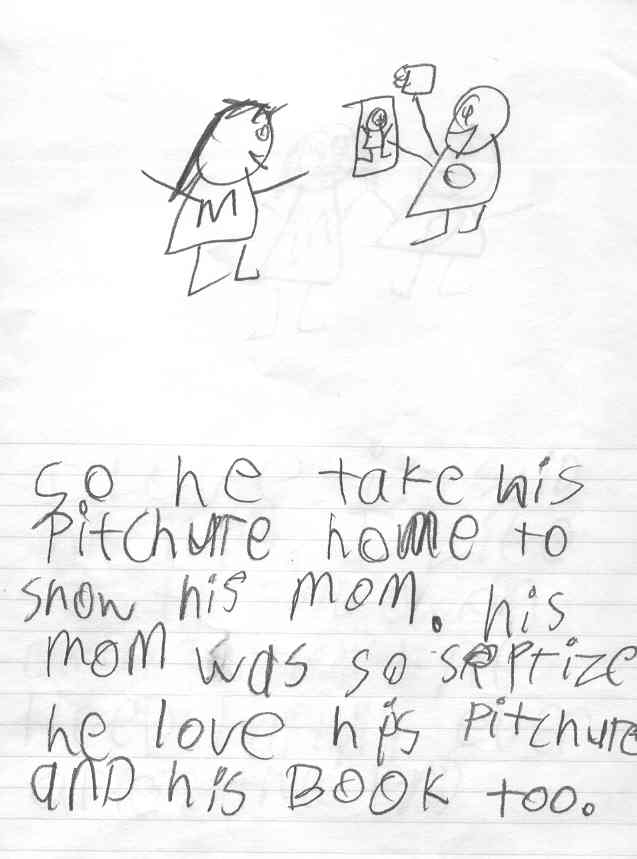
Moms, you need to know that all this time, all this love, all this heartache is not lost on your children. They see it, they know it, even if they can't always tell you in a conventional way. Here's a little note from a friend of mine named Owen, drawn and written when he was in elementary school, that gives a little flavour of how important his mom is to him:


HAPPY MOTHER'S DAY!